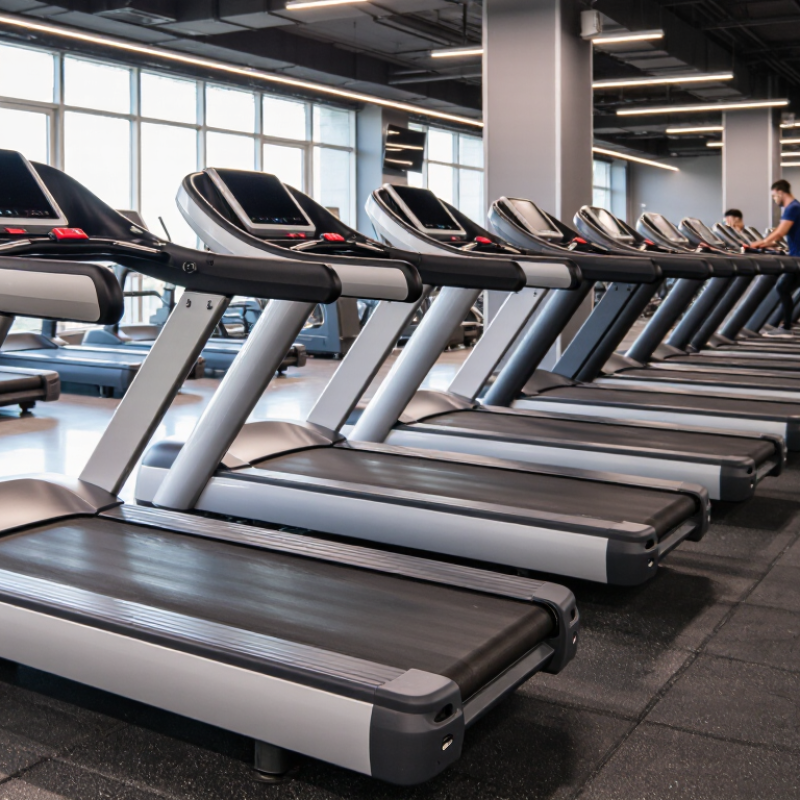
What Is a Commercial Treadmill? The answer involves more than a larger frame or a faster belt. A Commercial Treadmil is engineered for repeated, high-frequency use in gyms, hotels, rehabilitation centers, and corporate fitness rooms. It commonly includes a reinforced deck, durable rollers, a stronger cooling system, impact-resistant components, and accessible emergency-stop controls. These features help the machine withstand long operating hours and users with different running styles.
That distinction matters. The 2024 Health & Fitness Association Global Report describes a fitness industry continuing to recover and expand across major markets, increasing demand for reliable facility equipment. ACSM’s 2024 Worldwide Survey of Fitness Trends also places technology-supported training and data tracking among important industry priorities. A commercial treadmill therefore needs more than speed. It should support accurate performance data, stable operation, safe user transitions, and practical maintenance.
Evidence matters here. Manufacturers often highlight peak motor horsepower, yet continuous-duty performance, deck construction, warranty coverage, and service response may better reflect real-world value. A treadmill running eight hours daily faces different demands from one used twice weekly at home. Noise, belt alignment, ventilation, and cleaning access become visible concerns on a busy gym floor. Small failures can interrupt classes and affect member confidence.
The term is not perfectly standardized. Some brands label premium residential machines as commercial models, while others design equipment specifically for professional facilities. Buyers should compare duty-cycle ratings, applicable safety certifications, replacement-part availability, and independent user feedback. These details create a more reliable definition than marketing language alone. A Commercial Treadmil is ultimately a service-oriented training platform, not simply a powerful household machine. That difference deserves careful review.
A commercial treadmill is a heavy-duty running machine designed for repeated use in gyms, hotels, rehabilitation centers, and apartment fitness rooms. Its core purpose is reliable, measurable walking or running under frequent daily demand. Unlike a home treadmill, it usually has a stronger frame, a larger running deck, higher cooling capacity, and serviceable components. The design must tolerate many users, not just one household.
Demand explains its importance. The 2024 IHRSA Global Report estimated 184 million health club members worldwide in 2023. The 2024 Physical Activity Council report also recorded more than 20 million U.S. treadmill users. These figures show why facility equipment must support steady traffic. ASTM F2115 provides safety guidance for motorized treadmills, while proper installation still depends on the facility and operator. A treadmill can meet a standard and still perform poorly when maintenance is ignored. That distinction matters.
Tips: Check the motor rating, belt width, deck cushioning, emergency stop, noise level, and service access. Ask for duty-cycle information, not only peak horsepower. Place the machine on a stable, level surface. Leave enough space behind it for safe user movement. I have seen facilities choose narrow decks to save space, then regret the decision during busy hours. No treadmill fits every facility. Usage patterns should guide the final choice.
A commercial treadmill is built for repeated use, not occasional home exercise. The 2024 HFA Global Report recorded about 184 million fitness facility members worldwide. That scale explains why commercial machines need stronger frames, cooling systems, and serviceable parts.
The frame usually combines welded steel tubing with reinforced joints. It should remain stable when a runner lands heavily. A thick running belt reduces surface stress, while a multi-layer deck helps absorb impact. Deck boards also need practical replacement access. This detail is often overlooked.
The drive system includes a motor, controller, rollers, and belt-tracking hardware. A continuous-duty motor rating matters more than a brief peak figure. Large rollers can reduce belt bending and improve tracking. Still, bigger parts do not automatically mean better performance.
The console is another construction feature, not merely a screen. It should show speed, incline, time, distance, and emergency-stop status clearly. Handrails need firm mounting and a shape that supports changing grips. According to ASTM F2116, motorized treadmills require attention to structural integrity, guarding, and user safety.
Ventilation protects the motor and electronics during busy operating hours. Yet airflow design can collect dust under the hood. That weakness deserves regular inspection. A commercial treadmill should also provide accessible lubrication points, diagnostic access, and replaceable wear components. Those details may appear boring, but they often determine long-term operating cost.
What Is a Commercial Treadmill?
How Commercial Treadmills Differ from Home Models
A commercial treadmill is designed for repeated use in gyms, clinics, hotels, and training facilities. Its frame is usually heavier, and its running belt often feels wider and more stable. Stronger cooling systems help the motor manage longer sessions. That matters when many users run throughout the day.
Home models usually prioritize compact size, lower noise, and easier storage. They may work well for walking or moderate jogging, but their duty cycle is often more limited. A commercial treadmill can tolerate frequent starts, heavier users, and varied speeds. However, “commercial” does not automatically mean better for everyone. It can mean more space, more electricity, and a higher maintenance burden.
Tips: Check the maximum user weight, belt dimensions, motor rating, and service support. Stand on the deck before buying. A firm deck may suit runners, while a softer feel can help walkers. Listen for motor noise and belt movement. Small details matter.
In professional facilities, technicians also inspect alignment, lubrication, emergency stops, and cooling vents. These checks protect performance and reduce avoidable wear. Still, specifications can be confusing. Motor power figures do not always predict real-world smoothness. A well-built home treadmill may outperform a poorly maintained commercial unit. The right choice depends on usage, available room, noise tolerance, and maintenance expectations.
Commercial treadmills are engineered for frequent, high-volume use in gyms, hotels, rehabilitation centers, and other shared facilities. Compared with typical home models, they generally provide a larger running surface, a stronger continuous-duty motor, and a higher user-weight capacity.
How to read the chart: The index compares typical midpoint specifications, with a home treadmill set at 100. Commercial models commonly offer approximately a 60-inch × 22-inch running deck, a 4.0 CHP motor, and a 450-pound user-weight capacity, while home models commonly offer approximately a 55-inch × 20-inch deck, a 3.0 CHP motor, and a 350-pound capacity.
Actual specifications vary by model. CHP means continuous horsepower, a useful measure of sustained motor output under normal operating conditions.
What Is a Commercial Treadmill?
Common Settings and Users
A commercial treadmill is designed for repeated, high-volume use in shared facilities. It usually has a stronger frame, larger motor, durable belt, and serviceable components. These details matter when dozens of people run on the same machine daily. A home treadmill may support one household. A commercial model must tolerate changing users, speeds, body weights, and training habits.
Common settings include gyms, hotels, apartment fitness rooms, universities, workplaces, and rehabilitation centers. Users may walk slowly after an injury, jog during lunch, or run steep intervals before work. The American College of Sports Medicine recommends regular aerobic activity, while the Centers for Disease Control and Prevention advises adults to complete at least 150 minutes of moderate activity weekly. A treadmill makes that target measurable through speed, time, incline, and heart-rate monitoring.
Demand is not theoretical. The Health & Fitness Association reported approximately 184 million fitness-facility members worldwide in 2023. The ACSM Worldwide Survey of Fitness Trends also continues to rank wearable technology highly, showing stronger interest in measurable training. Still, numbers can mislead. A display may show distance, but it cannot confirm correct posture or safe effort. Staff supervision remains important, especially for older adults and rehabilitation users. The overlooked issue is maintenance. A noisy belt, inaccurate incline, or delayed emergency stop can change the user experience quickly. Even a powerful treadmill needs inspection, cleaning, and sensible programming.
| Category | Common Setting or Feature | Typical Commercial Specification | Primary Purpose | Common Users |
|---|---|---|---|---|
| Operating Speed | Walking, jogging, and running speed | Approximately 0.5–20 km/h, depending on the model | Supports different training intensities and fitness levels | General members, runners, athletes, and rehabilitation users |
| Incline Adjustment | Motorized elevation of the running deck | Commonly 0–15%; some performance models offer a higher incline range | Simulates hills and increases cardiovascular or muscular demand | Fitness beginners, endurance runners, personal trainers, and athletes |
| Speed and Incline Controls | Console buttons, quick keys, and handrail controls | Allows rapid adjustment without leaving the running position | Improves workout control, convenience, and safety | All users, especially interval-training participants and coaches |
| Workout Programs | Manual, interval, hill, calorie, distance, and heart-rate programs | Preset programs vary by equipment configuration | Provides structured training without constant manual adjustments | First-time users, gym members, personal-training clients, and athletes |
| Heart-Rate Monitoring | Contact sensors and, on some models, wireless monitoring compatibility | Displays heart rate in beats per minute when compatible sensors are used | Helps users monitor training intensity | Cardio users, older adults, rehabilitation clients, and endurance athletes |
| Running Surface | Wide, long deck with cushioning or shock-reduction components | Often about 50–56 cm wide and 140–155 cm long | Provides room for a natural stride and frequent daily use | Walkers, joggers, runners, and high-traffic fitness facilities |
| Weight Capacity | Maximum recommended user weight | Frequently rated around 150–225 kg, depending on construction | Supports a broad user population and repeated commercial operation | Public gyms, hotels, residential complexes, and wellness centers |
| Motor and Duty Cycle | Continuous-duty motor designed for repeated operation | Commercial units commonly use approximately 3–5 continuous horsepower, although ratings vary | Maintains performance during frequent workouts and heavier use | Commercial gyms, sports clubs, universities, and corporate fitness rooms |
| Safety Features | Emergency stop, safety clip, side rails, and controlled acceleration | Safety equipment and functions vary by model and applicable regulations | Reduces risk during mounting, dismounting, and unexpected loss of balance | All users, particularly beginners, older adults, and rehabilitation clients |
| Console Metrics | Speed, time, distance, incline, calories, and heart rate | Real-time workout data shown on an integrated display | Makes progress easier to track and training easier to manage | Members, trainers, coaches, and facility operators |
| Connectivity | USB charging, Bluetooth, entertainment, or network connectivity | Availability depends on the console and facility technology | Improves engagement and may support digital workout tracking | Technology-focused gyms, hotels, corporate facilities, and regular members |
| Typical Commercial Users | Shared equipment used by multiple people each day | Designed for higher durability and usage frequency than most home-only units | Accommodates varied fitness goals in a shared environment | Health clubs, hotels, apartment complexes, universities, sports facilities, and rehabilitation centers |
Note: Specifications are representative ranges for commercial-grade treadmills; exact settings, capacities, and features vary by equipment model and facility requirements.
What Is a Commercial Treadmill?
Important Factors When Selecting a Commercial Treadmill
A commercial treadmill is built for repeated, high-volume use in gyms, hotels, rehabilitation centers, and athletic facilities. The Health & Fitness Association’s 2024 Global Report recorded about 184 million fitness club members worldwide in 2023. That scale increases demand for dependable equipment. Selection should begin with expected daily usage, not appearance.
Choose a continuous-duty motor instead of trusting peak horsepower claims. A wider belt, stable frame, and strong deck reduce vibration during fast intervals. Check the belt length for taller users and examine the cushioning system in person. Excessive softness may feel comfortable initially, but it can change running mechanics. The incline range, emergency-stop design, maximum user weight, and speed accuracy also matter. ASTM fitness-equipment guidance can support safety checks, although local requirements still need professional review. A high specification is not always a better investment. Maintenance access may matter more.
Tips: Count expected sessions per day, then add capacity for busy hours. Ask for noise readings and service intervals. Inspect the underside of the deck. Compare the warranty with local technician availability. The 2024 ACSM Worldwide Survey placed wearable technology first among global fitness trends, so clear performance tracking deserves attention. However, screens can distract users and raise repair costs. Test the console with wet hands and gloves. Small details often expose weak design. One imperfect assumption remains common: every facility values entertainment equally. Many users still want simple controls, stable footing, and a treadmill that starts immediately.